Uncategorized
DMT and the Brain: Mechanism, Serotonin & Current Research
Oct
DMT and the brain have become an important area of psychedelic neuroscience because N,N-dimethyltryptamine can rapidly and profoundly alter perception, consciousness, emotion and sensory processing.
The best-established explanation involves the brain’s serotonin system, particularly the 5-HT2A receptor. However, DMT is pharmacologically more complicated than a single-receptor drug.
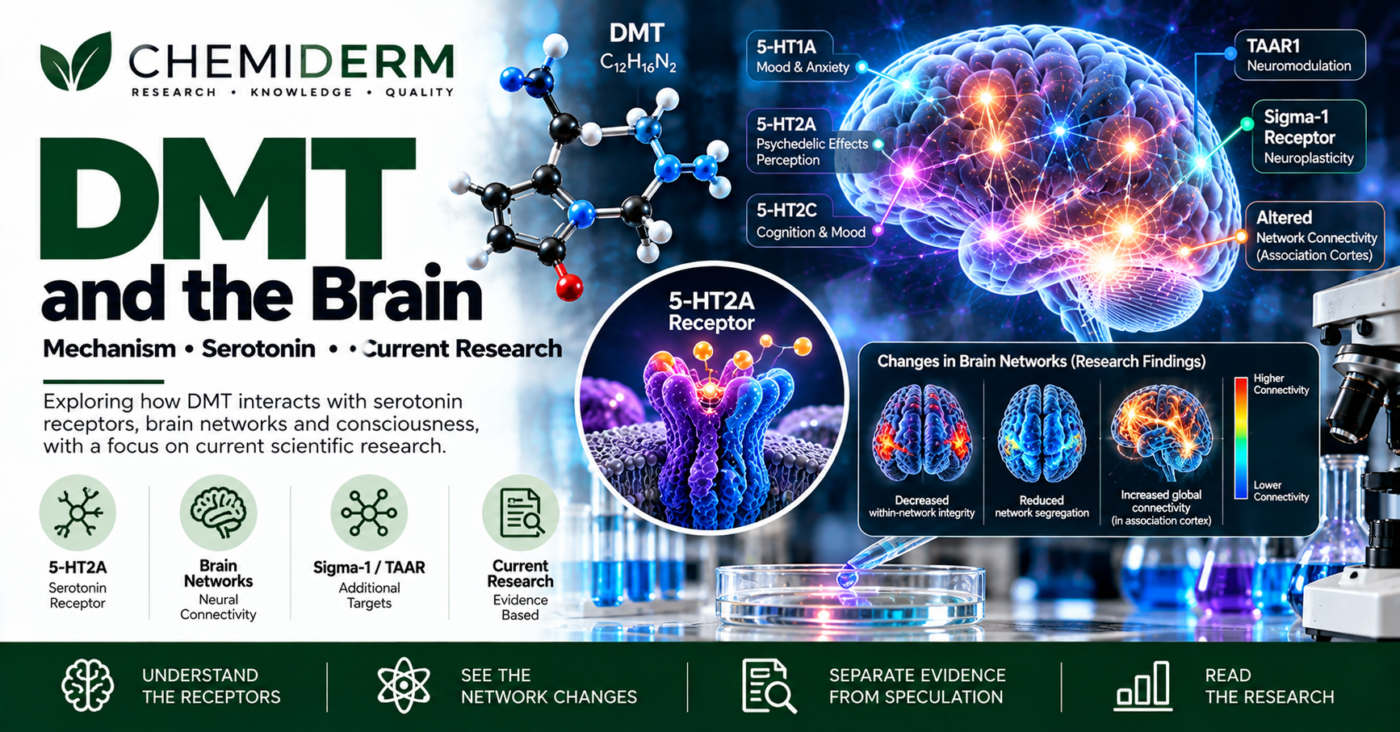
Research suggests that it can interact with several serotonin receptor subtypes and may also affect other molecular targets, including trace amine-associated receptors and sigma-1 receptors.
Brain-imaging research adds another layer: under DMT, normal functional networks become less internally organized and less segregated from one another, while global communication between certain higher-order brain regions increases.
This guide explains what scientists currently know about DMT’s effects on the brain—and where the evidence remains uncertain.
For more evidence-focused pharmacology content, visit Chemiderm.com.
What Is DMT?
DMT stands for N,N-dimethyltryptamine.
It belongs to the tryptamine family and is generally classified as a classic serotonergic psychedelic.
Its molecular structure resembles serotonin closely enough for DMT to interact with several serotonin receptors in the nervous system.
That does not mean DMT simply behaves like serotonin.
Its pattern of receptor activity produces dramatically different effects on perception and consciousness.
For a broader introduction, read our guide on What Is DMT?
What Is the Main DMT Mechanism of Action?
The most established mechanism involves serotonin receptors.
DMT acts as an agonist or partial agonist at multiple serotonin receptor subtypes, including:
- 5-HT1A
- 5-HT1B
- 5-HT1D
- 5-HT2A
- 5-HT2B
- 5-HT2C
- 5-HT6
- 5-HT7
DMT and the Brain
Among these, the 5-HT2A receptor receives the most attention because it is strongly associated with the psychedelic effects of classic hallucinogens.
However, current pharmacology suggests that 5-HT2A activation is important but does not explain every effect of DMT by itself.
DMT and the 5-HT2A Receptor
The 5-HT2A receptor is one of the central molecular targets in psychedelic neuroscience.
It is widely distributed in the brain, particularly in cortical areas involved in:
- Perception
- Cognition
- Attention
- Sensory integration
- Self-processing
Modern reviews of psychedelic medicine continue to describe classic psychedelics as compounds whose profound effects on brain function are strongly linked to 5-HT2A receptor activity.
DMT’s interaction with this receptor likely contributes substantially to its intense perceptual and consciousness-altering effects.
Why Serotonin Matters
Serotonin, or 5-hydroxytryptamine, is a neurotransmitter involved in many biological functions.
These include:
- Mood
- Sleep
- Cognition
- Appetite
- Anxiety
- Sensory processing
- Emotional regulation
Psychedelics do not simply increase serotonin in the same way across the brain.
Instead, compounds such as DMT directly interact with serotonin receptors and alter signalling patterns.
This distinction matters when explaining DMT pharmacology.
Does DMT Affect Other Serotonin Receptors?
Yes.
DMT interacts with a broader range of serotonergic receptors than 5-HT2A alone.
Research has identified activity at receptors including:
- 5-HT1A
- 5-HT2C
- 5-HT6
- 5-HT7
These additional receptor interactions may influence mood, cognition, perception and autonomic effects.
Exactly how much each receptor contributes to the complete DMT experience remains under investigation.
DMT and Glutamate
Serotonin signalling can also affect glutamate.
One influential model of classic psychedelic action suggests that cortical 5-HT2A activation increases glutamate signalling in frontal brain regions.
Glutamate is the brain’s principal excitatory neurotransmitter.
This downstream activity may contribute to major changes in:
- Neural communication
- Sensory integration
- Cortical processing
- Cognitive flexibility
Reviews of DMT pharmacology describe frontocortical glutamate release as one possible mechanism connecting serotonin receptor activation with broader psychedelic effects.
What Happens to Brain Networks on DMT?
Modern imaging studies provide some of the most interesting evidence.
An EEG-fMRI study of human participants found that DMT significantly reduced the internal integrity of most canonical resting-state brain networks.
At the same time, researchers observed reduced separation between normally distinct networks and increased global functional connectivity in several higher-order regions.
In simpler terms:
brain networks that normally operate more independently begin communicating in less segregated ways.
What Is Network Segregation?
The healthy brain is organized into specialized functional networks.
Examples include:
- Default mode network
- Frontoparietal network
- Salience network
- Visual networks
- Sensorimotor networks
Under normal waking conditions, these systems maintain a degree of separation while still communicating.
DMT research suggests that some of these boundaries become less distinct during the psychedelic state.
This may contribute to experiences involving unusual combinations of:
- Thoughts
- Sensations
- Memories
- Emotions
- Visual imagery
DMT and the Default Mode Network
The default mode network, often abbreviated DMN, is associated with processes including:
- Self-referential thought
- Autobiographical memory
- Internal reflection
- Sense of self
The human DMT imaging study found altered connectivity involving the default mode network along with frontoparietal and salience networks.
Researchers are interested in whether these changes help explain phenomena such as:
- Ego dissolution
- Altered self-boundaries
- Loss of ordinary self-reference
These remain areas of active investigation rather than fully settled conclusions.
Does DMT Increase Brain Connectivity?
In certain respects, yes.
The same EEG-fMRI research reported increased global functional connectivity in regions overlapping higher-order association cortex.
This does not mean every brain region becomes more connected to every other region.
A more accurate summary is:
- Some networks lose internal stability
- Separation between networks decreases
- Certain higher-order regions show greater global connectivity
The overall picture is one of less rigid network organization.
DMT and Brain Entropy
Psychedelic neuroscience frequently discusses the idea of increased brain entropy.
This generally refers to more diverse or less predictable patterns of neural activity.
DMT imaging studies are consistent with a state in which brain activity becomes less constrained by ordinary network boundaries.
Researchers have proposed that this increased neural flexibility may relate to the unusual complexity of psychedelic consciousness.
Does DMT Affect the Sigma-1 Receptor?
Yes, but the significance is less clear than with serotonin receptors.
Laboratory research has demonstrated that DMT can bind to and activate the sigma-1 receptor.
Sigma-1 receptors are molecular chaperones involved in cellular functions such as:
- Calcium signalling
- Cellular stress responses
- Ion-channel regulation
- Communication between the endoplasmic reticulum and mitochondria
However, DMT’s affinity for sigma-1 receptors is substantially weaker than its affinity for 5-HT2A receptors.
For that reason, sigma-1 activity should be described as an additional possible mechanism rather than the primary established explanation for psychedelic effects.
DMT and TAAR1
Another proposed molecular target is trace amine-associated receptor 1, or TAAR1.
Laboratory studies have shown that DMT can activate TAAR1 and stimulate intracellular signalling.
However, researchers still do not know how important TAAR1 is to the human psychedelic experience.
Compared with 5-HT2A, the evidence is much less developed.
Does DMT Affect Dopamine?
DMT can interact indirectly or weakly with several neurotransmitter systems.
However, its affinity for dopamine receptors appears much lower than its affinity for primary serotonergic targets.
This is one reason DMT is best described as a serotonergic psychedelic rather than a primarily dopaminergic drug.
DMT and Consciousness
DMT attracts scientific interest because it can produce dramatic alterations in consciousness over a short period.
Researchers study phenomena including:
- Ego dissolution
- Altered time perception
- Complex imagery
- Changes in body awareness
- Altered spatial perception
- Unusual emotional states
Brain imaging suggests these experiences occur alongside substantial changes in large-scale neural communication.
However, scientists still cannot map each specific subjective experience to one single brain mechanism.
Does DMT Shut Down the Brain?
No.
This is a common misconception.
DMT does not simply turn brain activity off.
Research instead indicates a reorganization of brain-network dynamics, including reduced network integrity and increased communication across normally more segregated systems.
That is very different from global brain shutdown.
Does DMT Make the Brain More Active?
This question is also too simple.
Some measures of brain organization decrease, while other measures of communication increase.
For example:
- Within-network integrity can decline
- Network segregation can decrease
- Global connectivity can increase in some association regions
Therefore, it is more accurate to say that DMT reorganizes patterns of brain activity rather than simply increasing or decreasing overall activity.
Is DMT Naturally Produced in the Brain?
DMT has been detected in mammalian biology, and animal research has investigated endogenous production.
However, the exact biological role of naturally occurring DMT remains unresolved.
Researchers have proposed possible physiological roles, but none has been conclusively established.
Does the Pineal Gland Produce DMT?
The idea that the pineal gland releases large amounts of DMT during dreams, birth or near-death experiences is popular online.
Scientific evidence does not currently establish that claim in humans.
Research into endogenous DMT remains legitimate, but claims about large psychedelic releases during specific experiences remain speculative.
This is an important distinction between scientific evidence and internet mythology.
Is DMT the Cause of Dreams?
There is no established evidence showing that DMT is responsible for ordinary dreaming.
The hypothesis is interesting but unproven.
Current research has not demonstrated that endogenous DMT concentrations reach levels necessary to explain normal dream states.
DMT and Near-Death Experiences
DMT experiences and near-death experiences sometimes share reported features such as:
- Altered perception
- Intense imagery
- Distortion of time
- Feelings of transcendence
However, similarity does not prove that endogenous DMT causes near-death experiences.
Reviews of endogenous DMT research emphasize that its natural physiological function remains uncertain.
Can DMT Change the Brain Long Term?
This remains an important research question.
Most human DMT imaging studies focus on acute effects.
Scientists are also studying whether psychedelics more broadly may influence:
- Neuroplasticity
- Emotional processing
- Cognitive flexibility
- Network organization
But evidence for persistent DMT-specific structural brain changes in humans remains limited.
Claims that DMT permanently “rewires the brain” should therefore be treated cautiously.
Is DMT Neuroprotective?
Preclinical research has generated interest in possible sigma-1-mediated and anti-inflammatory effects.
Some laboratory work suggests DMT may influence inflammatory signalling and cellular stress pathways.
However, preclinical findings do not establish DMT as a proven neuroprotective treatment in humans.
More research is necessary.
Is DMT Being Studied for Mental Health Treatment?
Yes.
DMT and related psychedelics are increasingly studied in psychiatric and neuroscience research.
Areas of investigation include:
- Depression
- Consciousness
- Emotional processing
- Neuroplasticity
- Psychedelic-assisted psychotherapy
A major 2026 review in Nature Medicine describes significant progress in understanding psychedelic mechanisms and clinical potential while emphasizing the importance of rigorous research.
Experimental promise should not be confused with established routine medical treatment.
DMT and 5-MeO-DMT: Are Their Brain Effects the Same?
No.
Both are serotonergic tryptamines, but they have different receptor profiles.
5-MeO-DMT shows particularly strong affinity for 5-HT1A receptors, while DMT is more characteristic of classic 5-HT2A-mediated psychedelic pharmacology.
Read our 5-MeO-DMT vs DMT guide for the full comparison.
DMT Brain Effects at a Glance
| Brain Target/System | Current Understanding |
|---|---|
| 5-HT2A | Major contributor to psychedelic effects |
| 5-HT1A | Additional serotonergic activity |
| 5-HT2C | May contribute to broader serotonergic effects |
| Glutamate | Likely involved downstream of cortical serotonin signalling |
| TAAR1 | DMT can activate it, but human significance remains uncertain |
| Sigma-1 | DMT binds this receptor; psychedelic importance remains unclear |
| Brain networks | Reduced integrity and segregation with increased connectivity in some association regions |
How This Fits Into the Chemiderm DMT Research Hub
This article forms part of the DMT research cluster on Chemiderm.com.
Related resources include:
- What is DMT?
- 5-MeO-DMT vs DMT
- How long does DMT last?
- DMT mechanism of action
- DMT risks and side effects
- Ayahuasca explained
- Changa explained
- Serotonin and neurotransmitters
- Psychedelic research
Each page targets a different search question while strengthening the wider topical cluster.
Frequently Asked Questions
What does DMT do to the brain?
DMT primarily alters serotonergic signalling and significantly reorganizes large-scale brain-network activity, including reduced network segregation and altered global connectivity.
What receptor does DMT act on?
The 5-HT2A serotonin receptor is considered the most important established target for its classic psychedelic effects, although DMT interacts with several other receptors as well.
Does DMT increase serotonin?
DMT does not simply increase serotonin. It directly interacts with multiple serotonin receptors and alters serotonergic signalling.
Does DMT affect the default mode network?
Yes. Human imaging studies have found altered default-mode network connectivity and reduced segregation between major brain networks under DMT.
Does DMT shut the brain down?
No. Research suggests reorganization of neural connectivity rather than overall brain shutdown.
Does DMT affect sigma-1 receptors?
Yes. Laboratory research shows DMT can activate sigma-1 receptors, although their role in psychedelic effects remains less established than 5-HT2A signalling.
Is DMT naturally found in the brain?
Evidence supports endogenous DMT production in mammalian biology, but its normal physiological role remains uncertain.
Does the brain release DMT when you die?
There is currently no conclusive evidence demonstrating a large DMT release in the human brain at death.
Final Thoughts
Current evidence suggests that DMT affects the brain primarily through serotonergic signalling, especially the 5-HT2A receptor, while also interacting with several additional molecular systems.
Human brain imaging shows that DMT reduces the normal integrity and separation of major functional networks while increasing global connectivity in parts of higher-order association cortex.
Researchers are also studying sigma-1 receptors, TAAR1, glutamate signalling and possible neuroplastic effects, but these mechanisms are less firmly established.
The most important lesson is that DMT neuroscience is far more complex than claims that it simply “activates the brain” or is responsible for dreams and near-death experiences.
For more evidence-based psychedelic and neuroscience research, visit Chemiderm.com.
DMT and the BrainDMT and the BrainDMT and the BrainDMT and the BrainDMT and the BrainDMT and the BrainDMT and the BrainDMT and the BrainDMT and the BrainDMT and the BrainDMT and the BrainDMT and the BrainDMT and the BrainDMT and the BrainDMT and the BrainDMT and the BrainDMT and the BrainDMT and the BrainDMT and the BrainDMT and the Brain
