Uncategorized
What Is DMT? Effects, Duration, Risks & Legal Status
Oct
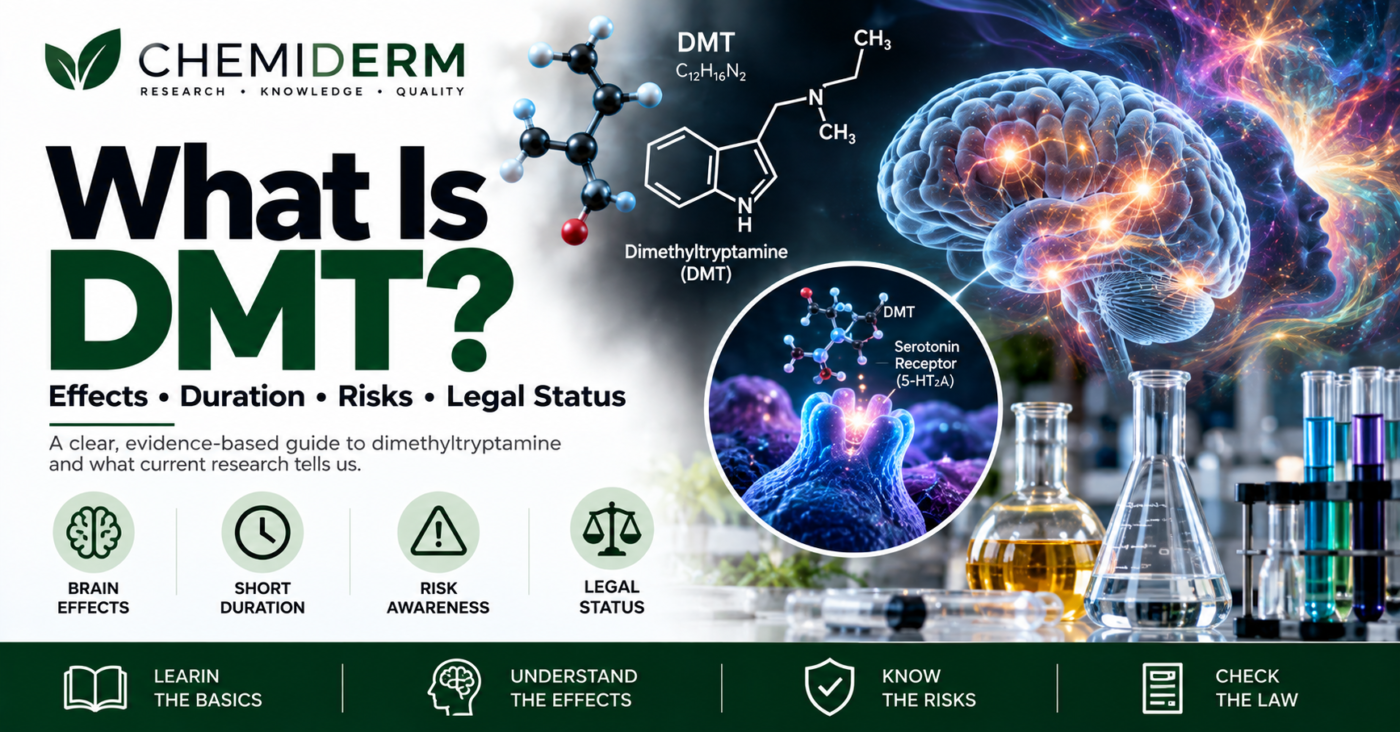
What is DMT? DMT, short for N,N-dimethyltryptamine, is a powerful psychedelic compound belonging to the tryptamine family.
It is best known for producing intense changes in perception, visual experience, sense of time, emotion and awareness. DMT acts in part through serotonin-related systems in the brain, including 5-HT receptors.
Interest in DMT has grown substantially in recent years because of scientific research into consciousness, psychedelic pharmacology and potential therapeutic applications.
At the same time, DMT carries real psychological and physiological risks, and its legal status is highly restricted in many jurisdictions.
This Chemiderm guide explains what DMT is, what current research says about its effects, how long its effects may last, how it interacts with the brain and what people should know about safety and legality.
For more science and research information, visit Chemiderm.com.
What Does DMT Stand For?
DMT stands for:
N,N-Dimethyltryptamine
It belongs to a chemical family known as tryptamines.
Its molecular structure shares similarities with several naturally occurring compounds involved in biological signalling.
DMT should not be confused with 5-MeO-DMT.
Although both belong to the tryptamine family and are sometimes grouped together in online discussions, they are chemically distinct substances with different pharmacological profiles.
A separate Chemiderm guide will examine 5-MeO-DMT vs DMT in more detail.
What Type of Drug Is DMT?
DMT is generally classified as a classic psychedelic or hallucinogen.
Classic psychedelics alter perception, sensory processing, emotion and consciousness largely through interactions with serotonin receptors.
NIDA notes that DMT produces effects through serotonin receptor activity and can cause hallucinations, altered environments and distortions in body and spatial perception.
Other classic psychedelics include substances such as:
- LSD
- Psilocybin
- Mescaline
Although these substances share certain pharmacological features, their duration and subjective effects can differ substantially.
How Does DMT Affect the Brain?
DMT affects several signalling systems, but serotonin activity is particularly important.
Research indicates that DMT interacts with serotonin receptors, including receptors involved in perception, mood and cognition.
This activity is thought to contribute to effects such as:
- Intense visual experiences
- Changes in perceived space
- Altered sense of time
- Emotional shifts
- Changes in body perception
- Unusual sensory experiences
Researchers are still investigating the full pharmacology of DMT.
The compound may interact with more than one receptor system, so describing it simply as a “serotonin drug” would be an oversimplification.
DMT and Serotonin
Serotonin is a neurotransmitter involved in many functions, including:
- Mood
- Sleep
- Perception
- Appetite
- Cognition
- Emotional processing
Classic psychedelics are strongly associated with serotonin receptor activity.
DMT’s psychoactive effects are particularly linked to serotonin-related signalling pathways.
This is one reason DMT is frequently studied alongside other serotonergic psychedelics.
Our future Chemiderm article on serotonin, GABA and neurotransmitters will explain these signalling systems in greater detail.
What Are the Effects of DMT?
DMT can produce very intense perceptual and psychological effects.
Reported effects include:
- Visual hallucinations
- Altered sensory perception
- Distortion of body awareness
- Altered perception of space
- Changes in time perception
- Rapid emotional shifts
- Feelings of fear or euphoria
- Disorientation
- Intense internal imagery
NIDA specifically identifies increased heart rate, agitation and hallucinations involving dramatically altered environments and spatial or body distortions among short-term DMT effects.
Experiences can vary substantially between individuals.
How Long Does DMT Last?
One feature that distinguishes DMT from many other classic psychedelics is its comparatively brief duration when administered by rapidly absorbed routes in clinical or experimental research.
Published reviews report that subjective effects from intravenous DMT typically peak within several minutes and may largely resolve within around 20–30 minutes. Intramuscular administration has been reported to last approximately 30–60 minutes.
When DMT is present in ayahuasca, the time course can be much longer because other compounds inhibit enzymes that would otherwise rapidly metabolize it. Research reviews describe ayahuasca-related subjective effects lasting for several hours.
Because duration depends heavily on pharmacology and route of exposure, there is no single universal time that applies to every DMT-related preparation.
Our next dedicated article will cover how long DMT lasts in more detail.
Why Is DMT Usually Short Acting?
DMT is rapidly metabolized by enzymes in the body, particularly monoamine oxidase A, commonly abbreviated as MAO-A.
That rapid metabolism contributes to its relatively brief effects in some research settings.
This also helps explain why preparations containing monoamine oxidase inhibitors can produce a much longer pharmacological effect.
DMT vs 5-MeO-DMT
DMT and 5-MeO-DMT are not the same substance.
Both are tryptamines, but their:
- Chemical structures
- Receptor activity
- Subjective effects
- Research profiles
are different.
The distinction matters because the phrases are often incorrectly used interchangeably online.
A dedicated article in this Chemiderm series will compare 5-MeO-DMT vs DMT.
DMT vs Psilocybin
DMT and psilocybin are both serotonergic psychedelics, but they differ significantly in duration and pharmacokinetics.
DMT can have a very rapid and relatively brief time course under certain research conditions, while psilocybin experiences generally last considerably longer.
They should therefore not be treated as interchangeable substances.
DMT vs Ayahuasca
DMT is a specific chemical compound.
Ayahuasca is a traditional preparation that may contain DMT-containing plant material alongside compounds that inhibit monoamine oxidase.
This interaction changes how DMT is metabolized and dramatically extends the duration compared with rapidly absorbed DMT studied alone.
A separate Chemiderm guide will explain ayahuasca, MAOIs, effects and risks.
Is DMT Naturally Present in the Human Body?
DMT has been detected in mammals, and researchers have investigated whether endogenous DMT may play biological roles.
However, dramatic claims that DMT is definitively responsible for dreams, near-death experiences or mystical experiences remain unproven.
NIDA has noted that theories linking naturally produced DMT to such phenomena remain controversial.
This is an important distinction between established evidence and internet speculation.
Does DMT Cause Hallucinations?
Yes. Hallucinations and dramatic perceptual changes are among the best-known acute effects associated with DMT.
Research reports include:
- Visual imagery
- Altered environments
- Distortion of body position
- Changes in spatial perception
- Distorted sensory experiences
These effects can be psychologically intense and may be frightening.
Can DMT Cause a Bad Trip?
Psychedelic experiences can sometimes become extremely distressing.
Possible reactions may include:
- Panic
- Severe anxiety
- Paranoia
- Confusion
- Fear of losing control
- Disturbing hallucinations
NIDA describes severe anxiety and frightening reactions as recognized risks of hallucinogenic experiences.
People with certain psychiatric vulnerabilities may be at greater risk of adverse psychological effects.
What Are the Physical Risks of DMT?
Research has reported physiological changes including:
- Increased heart rate
- Increased blood pressure
- Agitation
- Nausea
- Changes in body temperature
These effects may be especially relevant to people with cardiovascular or other medical conditions.
DMT should not be described as risk-free simply because some effects are short-lived.
Can DMT Trigger Psychosis?
Hallucinogens and other psychoactive substances can contribute to severe psychological reactions in susceptible individuals.
Clinical literature has documented that psychedelic exposure can occasionally be associated with prolonged psychiatric symptoms, although such outcomes are uncommon in carefully screened research settings.
Drug misuse more broadly can also trigger psychotic episodes in some people.
Anyone experiencing persistent hallucinations, severe confusion, paranoia or loss of contact with reality should seek medical help.
Is DMT Addictive?
DMT does not fit neatly into the same dependence pattern seen with substances such as opioids, nicotine or benzodiazepines.
However, this does not make it harmless.
A substance can carry significant psychological, behavioral or medical risk without causing classic physical dependence.
What Are the Long-Term Effects of DMT?
Long-term human data are more limited than the information available for many common medicines.
Researchers continue to investigate:
- Persistent perceptual changes
- Psychological outcomes
- Therapeutic potential
- Psychiatric risks
- Effects of repeated psychedelic exposure
Claims that DMT is either completely harmless or inherently therapeutic go beyond current evidence.
Is DMT Being Studied Medically?
Yes.
Modern psychedelic research has renewed scientific interest in DMT and related compounds.
Researchers are studying topics including:
- Consciousness
- Depression
- Neurobiology
- Psychedelic-assisted therapy
- Pharmacokinetics
- Brain-network changes
Experimental research does not mean that unsupervised use has been established as safe or effective treatment.
Is DMT Legal in the United States?
Under United States federal law, dimethyltryptamine is listed as a Schedule I controlled substance. The DEA’s controlled-substance resources specifically list dimethyltryptamine, or DMT, in Schedule I.
Schedule I status means federal law places very strict controls on possession, manufacture and distribution outside authorized research or other legally permitted contexts.
Is DMT Legal Everywhere?
No.
Drug laws differ between countries and may also involve state, provincial or local rules.
Anyone researching DMT’s legal status should check current official government sources in their jurisdiction rather than relying on forum posts, old articles or commercial websites.
DMT Research vs Internet Claims
DMT attracts an unusually large amount of speculation online.
Common claims involve:
- DMT entities
- Near-death experiences
- Dreams
- Mystical experiences
- Consciousness theories
- Endogenous DMT release
Some of these topics are being researched, but many popular claims remain speculative.
Good science distinguishes between:
What has been demonstrated
and
What has merely been proposed.
This principle is central to Chemiderm’s research-focused approach.
How This Article Fits Into the Chemiderm DMT Research Hub
This page serves as the main DMT pillar article on Chemiderm.com.
Related articles in the cluster will cover:
- 5-MeO-DMT vs DMT
- How long DMT lasts
- DMT and the brain
- Ayahuasca explained
- Changa explained
- Serotonin and neurotransmitters
- Psychedelic risk and safety research
Building the series this way allows each page to answer a specific search question without having multiple posts compete for exactly the same keyword.
Frequently Asked Questions
What does DMT stand for?
DMT stands for N,N-dimethyltryptamine.
What type of drug is DMT?
DMT is generally classified as a classic psychedelic or hallucinogen.
What does DMT do to the brain?
DMT alters brain signalling involving serotonin receptors and produces major changes in perception, sensory processing and consciousness.
How long does DMT last?
Duration varies with pharmacology and route of exposure. In controlled research, rapidly absorbed DMT can produce effects lasting tens of minutes, while DMT-containing ayahuasca preparations can produce effects lasting several hours.
Does DMT cause hallucinations?
Yes. Hallucinations and strong distortions of perception are well-documented acute effects.
Is DMT the same as 5-MeO-DMT?
No. They are different chemical compounds.
Is DMT naturally produced in the body?
Endogenous DMT has been investigated scientifically, but claims about its exact physiological role remain uncertain.
Is DMT legal in the United States?
DMT is federally classified as a Schedule I controlled substance in the United States.
Final Thoughts
DMT is a potent, short-acting psychedelic compound that can cause dramatic changes in perception, emotion and awareness.
Scientific evidence links much of its psychedelic activity to serotonin-related signalling, while research continues into its pharmacology, brain effects and possible therapeutic applications.
Its short duration does not mean it is harmless.
Psychological distress, cardiovascular effects and severe reactions can occur, and legal restrictions remain substantial in many jurisdictions.
For more evidence-focused articles on psychedelics, pharmacology and neuroscience, visit Chemiderm.com.
What Is DMT
What Is DMTWhat Is DMTWhat Is DMTWhat Is DMTWhat Is DMTWhat Is DMTWhat Is DMTWhat Is DMTWhat Is DMTWhat Is DMTWhat Is DMTWhat Is DMTWhat Is DMTWhat Is DMTWhat Is DMTWhat Is DMTWhat Is DMT
