
Uncategorized
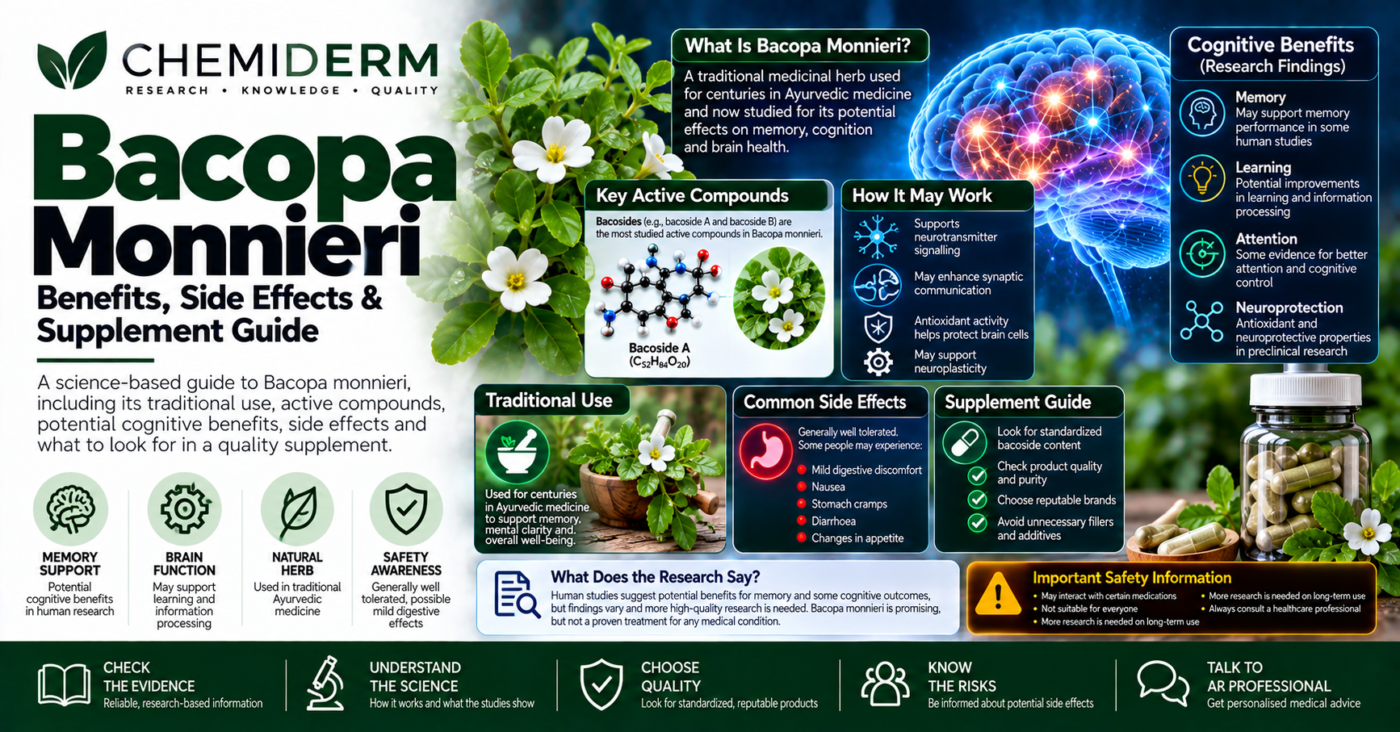
Bacopa Monnieri Benefits, Side Effects & Supplement Guide
Oct
Bacopa Monnieri Benefits
Bacopa monnieri is an herb traditionally used in Ayurvedic medicine and now widely marketed as a supplement for memory, learning, cognition and general brain health.
It is also commonly known as Brahmi, although that common name can sometimes be applied to other plants, so the scientific name Bacopa monnieri is important when comparing supplements.
Modern research has examined whether Bacopa may improve memory and other aspects of cognitive performance. Earlier systematic reviews found some evidence for improvements in memory recall, while newer analyses continue to suggest possible benefits in selected cognitive domains. However, the overall evidence is not uniform across all measures of cognition.
This guide examines what Bacopa monnieri is, what the clinical research says, possible side effects and what consumers should examine when comparing supplements.
For additional evidence-focused supplement and pharmacology content, visit Chemiderm.com.
What Is Bacopa Monnieri?
Bacopa monnieri is a small creeping herb that has been used traditionally in Ayurvedic medicine.
It is commonly associated with traditional claims involving:
- Memory
- Learning
- Mental clarity
- Concentration
- Stress resilience
Today, Bacopa extracts are frequently sold as dietary supplements and are often placed in the broader nootropic or cognitive-support category.
Scientific interest has focused particularly on a group of naturally occurring compounds called bacosides.
What Are Bacosides?
Bacosides are among the most studied phytochemical constituents of Bacopa monnieri.
Researchers have investigated whether these compounds may influence processes involving:
- Neuronal signalling
- Synaptic communication
- Oxidative stress
- Inflammation
- Cellular protection
Preclinical literature is extensive, but it is important to distinguish laboratory or animal findings from proven human clinical benefits.
A 2024 systematic review described potential neuroprotective mechanisms involving oxidative stress, inflammatory signalling, mitochondrial function and apoptosis, while also emphasizing the developing nature of the clinical evidence.
What Are the Main Claimed Bacopa Monnieri Benefits?
Bacopa is most commonly marketed for:
- Memory support
- Learning
- Attention
- Mental performance
- Healthy cognitive ageing
- Stress management
The scientific evidence is strongest for certain memory outcomes, rather than for a universal improvement in every area of cognition.
That distinction matters for responsible supplement marketing.
Bacopa Monnieri and Memory
Memory is the area with some of the longest-standing human research.
A systematic review of randomized controlled trials found that Bacopa supplementation improved performance on several tests of memory free recall. However, evidence for many other cognitive functions was considerably less consistent.
A separate meta-analysis involving randomized trials also suggested potential improvements in selected aspects of cognition and attention.
These findings are encouraging, but they do not mean Bacopa guarantees noticeable memory improvements for every person.
What Does Newer Research Say?
More recent research continues to investigate Bacopa as a cognitive supplement.
A 2026 network meta-analysis comparing Bacopa and Ginkgo in healthy adults found potentially favorable results for some Bacopa interventions in working and short-term memory. However, the authors noted important limitations, including indirect comparisons between interventions.
Another 2026 analysis of plant-based interventions found Bacopa-related products ranked well for selected executive and language outcomes, while attention-related effects were more limited.
The broader conclusion is that Bacopa appears promising, but the results depend heavily on the outcome being measured, extract used and study design.
Does Bacopa Improve Attention?
The answer is less certain than for memory.
Some studies and reviews report improvements in particular attention measures, while others show limited or inconsistent effects.
For example, one earlier meta-analysis suggested improvements in certain measures of speed of attention.
However, a more recent review of phytochemical cognitive interventions found no consistent Bacopa benefit across several areas, including attention, working memory and overall cognitive performance.
This disagreement is a good example of why supplement claims should be framed carefully.
Bacopa Monnieri and Learning
Memory and learning are closely related but not identical.
Human studies suggest Bacopa may influence:
- Delayed recall
- Memory acquisition
- Information retention
- Working-memory performance
However, benefits appear more convincing in some cognitive tests than others.
The evidence should therefore be described as potential cognitive support, not as proof that Bacopa universally improves intelligence or learning ability.
Bacopa and Healthy Adults
Much of the research has studied healthy adults rather than people diagnosed with neurological disease.
The 2012 systematic review, for example, examined adults without dementia or substantial cognitive impairment.
This means findings from healthy participants should not automatically be applied to people with Alzheimer’s disease or other forms of dementia.
Does Bacopa Treat Alzheimer’s Disease?
Current evidence does not establish Bacopa as a treatment for Alzheimer’s disease.
A systematic review of randomized trials involving Alzheimer’s disease found very low-certainty evidence and concluded that available studies did not demonstrate a clear advantage over placebo or donepezil.
Therefore, Bacopa should not be marketed as a replacement for established medical treatment for dementia.
Bacopa and Brain Health
Researchers are interested in several potential mechanisms that could theoretically support brain health.
These include:
- Antioxidant activity
- Modulation of inflammatory pathways
- Synaptic signalling
- Neurotransmitter activity
- Cellular stress responses
A 2024 systematic review summarized these possible mechanisms and highlighted potential neuroprotective effects, but much of the mechanistic evidence remains preclinical or preliminary.
How Long Has Bacopa Been Studied?
Bacopa has been used traditionally for centuries, but modern randomized clinical research is much more recent.
Many controlled studies run for several weeks rather than assessing immediate effects.
This is another reason Bacopa should not be presented as a stimulant that produces an immediate cognitive boost.
The scientific literature generally studies repeated supplementation over time.
Bacopa vs Ginkgo Biloba
Bacopa and Ginkgo are often marketed in the same cognitive-supplement category.
They are different plants containing different compounds.
A 2026 network meta-analysis attempted to compare them indirectly and found Bacopa performed favorably for some memory outcomes. However, the absence of direct head-to-head comparisons limits how confidently one can declare one herb superior.
Consumers should therefore be cautious with marketing phrases such as “better than Ginkgo” unless a claim is supported by appropriate evidence.
Is Bacopa a Nootropic?
The term nootropic is broadly used for substances intended to support cognitive performance.
Under that commercial definition, Bacopa is commonly classified as a natural nootropic.
However, the term itself does not guarantee clinical effectiveness.
A better question is:
Which cognitive outcomes have actually been demonstrated in controlled human studies?
For Bacopa, selected memory outcomes currently have more support than broad claims of universal cognitive enhancement.
What Are Common Bacopa Side Effects?
Bacopa has generally been tolerated in clinical studies, but side effects can occur.
The most commonly discussed effects tend to involve the digestive system, including:
- Nausea
- Abdominal discomfort
- Changes in bowel habits
- Stomach upset
Study reporting of adverse effects varies considerably, and long-term safety data are not as extensive as the data available for established prescription medicines.
A 2026 systematic review of Ayurvedic herbal products noted that reported adverse events were usually mild but were inconsistently captured across studies.
Is Bacopa Safe for Everyone?
No supplement should automatically be considered appropriate for everyone.
People should be particularly cautious if they:
- Take prescription medication
- Have a chronic medical condition
- Are pregnant or breastfeeding
- Are preparing for surgery
- Have experienced reactions to herbal supplements
Because herbal compounds can affect biological pathways and may interact with medicines, individualized medical advice may be appropriate.
Can Bacopa Interact With Medications?
Potential supplement-drug interactions are an important consideration.
The precise interaction profile depends on the extract, medication and individual medical situation.
People using prescription drugs should not assume that a botanical product is interaction-free simply because it is sold without a prescription.
A pharmacist or clinician can help review potential interactions.
How to Compare Bacopa Supplements
Bacopa products can differ substantially.
When comparing supplements, examine the label carefully rather than relying only on front-of-package marketing.
Important factors include:
1. Botanical Identity
Look for the scientific name:
Bacopa monnieri
This helps distinguish the plant from unrelated products marketed under similar traditional names.
2. Extract Information
Determine whether the product is:
- Whole herb
- Powder
- Standardized extract
- Combination supplement
Different preparations used in research are not necessarily interchangeable.
3. Bacoside Standardization
Some supplements state the percentage or quantity of bacosides.
Because bacosides are major studied constituents, this can provide more information than a label listing only total herb weight.
4. Third-Party Testing
Independent testing may help assess:
- Identity
- Contaminants
- Label accuracy
- Purity
5. Ingredient List
Check for additional ingredients such as:
- Stimulants
- Other nootropics
- Vitamins
- Herbal extracts
A combination product should not be assumed to provide the same evidence as Bacopa alone.
Why Extract Standardization Matters
Clinical trials have used different Bacopa extracts.
Even studies grouped under the same plant name may therefore involve products with different:
- Bacoside concentrations
- Extraction methods
- Plant material
- Manufacturing processes
This contributes to variability between study results.
It also means a consumer supplement should not automatically be assumed equivalent to an extract used in a clinical trial.
Should You Choose the Highest Bacoside Percentage?
Not necessarily.
“More” does not automatically mean “better.”
A higher concentration may change exposure and tolerability, while clinical results depend on the entire standardized preparation rather than one marketing number alone.
For supplements, quality, evidence and appropriate use are more important than simply choosing the largest number on the label.
Bacopa Powder vs Standardized Extract
Bacopa Powder
Usually contains dried plant material with naturally variable concentrations of constituents.
Standardized Extract
Designed to provide a more consistent concentration of selected compounds.
Research trials frequently use standardized extracts because researchers need greater consistency between participants.
This does not automatically make every standardized product clinically effective, but it makes the composition easier to define.
How Quickly Does Bacopa Work?
Bacopa should not be viewed as an immediate stimulant.
Many cognitive trials have assessed repeated supplementation over multiple weeks.
For example, the trials included in the classic systematic review lasted about 12 weeks.
That does not establish a required treatment duration for individuals; it simply describes how much of the research was conducted.
Does Bacopa Increase Intelligence?
There is no good evidence that Bacopa simply increases intelligence.
Researchers measure specific outcomes such as:
- Memory recall
- Processing speed
- Attention
- Working memory
- Executive function
A positive result on one test does not mean a person becomes broadly “smarter.”
SEO content should avoid overselling the science.
Bacopa and Stress
Some modern Bacopa studies also examine stress, mood and fatigue.
A randomized placebo-controlled trial published in 2025 investigated cognition, stress and fatigue in healthy adults, showing that research interest extends beyond memory alone.
However, these areas still require more replication before strong conclusions can be drawn.
Bacopa Research at a Glance
| Area | Current Evidence |
|---|---|
| Memory | Some supportive human evidence |
| Learning | Possible benefits in selected outcomes |
| Attention | Mixed evidence |
| Working memory | Some newer studies suggest benefit |
| Dementia treatment | Insufficient evidence |
| Neuroprotection | Mechanistically promising, much evidence preclinical |
| Long-term safety | More research needed |
Can Bacopa Replace Prescription Medication?
No.
Evidence supporting selected cognitive effects does not mean Bacopa should replace prescribed treatment for:
- Dementia
- Depression
- Anxiety disorders
- ADHD
- Neurological disease
Changing prescribed medication should be discussed with a qualified healthcare professional.
Natural Does Not Mean Risk-Free
The word natural is often used as a shorthand for safe.
That is not scientifically reliable.
Plants contain biologically active compounds, and those compounds can:
- Cause side effects
- Interact with medicines
- Vary between products
- Produce different effects at different exposures
The same caution used for other biologically active products should apply to supplements.
Bacopa Monnieri vs Other Nootropics
Bacopa differs from synthetic nootropics and compounds such as racetams.
It is a botanical extract containing many naturally occurring constituents rather than one synthetic molecule.
Our upcoming Chemiderm guide to racetams and nootropics will cover compounds such as phenylpiracetam, fasoracetam and oxiracetam separately.
How This Fits Into the Chemiderm Nootropics Hub
This article begins the natural cognitive-supplement section on Chemiderm.com.
Related articles will include:
- Bacopa monnieri benefits
- Racetams and nootropics
- Phenylpiracetam
- Fasoracetam
- Vitamin D3 and K2
- GABA and neurotransmitters
- Serotonin and brain signalling
- Supplement quality and safety
- Cognitive-support supplements
This structure allows Chemiderm to build topical authority around supplements without making unsupported medical claims.
Frequently Asked Questions
What is Bacopa monnieri?
Bacopa monnieri is an herb traditionally used in Ayurvedic medicine and currently studied for possible effects on cognition and memory.
Does Bacopa improve memory?
Some randomized trials and systematic reviews suggest potential improvements in selected memory outcomes, although effects are not consistent across every cognitive measure.
Is Bacopa a nootropic?
It is commonly marketed as a natural nootropic because of its association with cognitive support.
What are bacosides?
Bacosides are naturally occurring compounds in Bacopa monnieri that are frequently studied in relation to the herb’s biological effects.
Does Bacopa work immediately?
Most clinical research evaluates repeated supplementation over multiple weeks rather than immediate effects.
Can Bacopa treat Alzheimer’s disease?
Current evidence does not establish Bacopa as an effective Alzheimer’s treatment. A systematic review found very low-certainty evidence and no clear demonstrated benefit over placebo or donepezil.
What are the side effects of Bacopa?
Digestive effects such as nausea or stomach discomfort are among the more commonly reported issues, although safety reporting varies between trials.
What should I look for in a Bacopa supplement?
Look for correct botanical identification, clear extract information, stated bacoside content where applicable, transparent ingredients and reputable quality testing.
Final Thoughts
Bacopa monnieri is one of the better-studied botanical supplements in the cognitive-support category.
Human research provides some evidence for improvements in selected memory outcomes, while results for attention, processing speed and broader cognitive performance remain more mixed. Newer analyses continue to suggest promise, but study differences and indirect comparisons mean the evidence should not be overstated.
For consumers, the most sensible approach is to focus on product identity, extract quality, transparent standardization and safety rather than dramatic “brain booster” claims.
For additional evidence-based supplement, nootropic and pharmacology resources, visit Chemiderm.com.
