
Uncategorized
Benzodiazepines: Uses, Risks, Dependence & Major Types
Oct
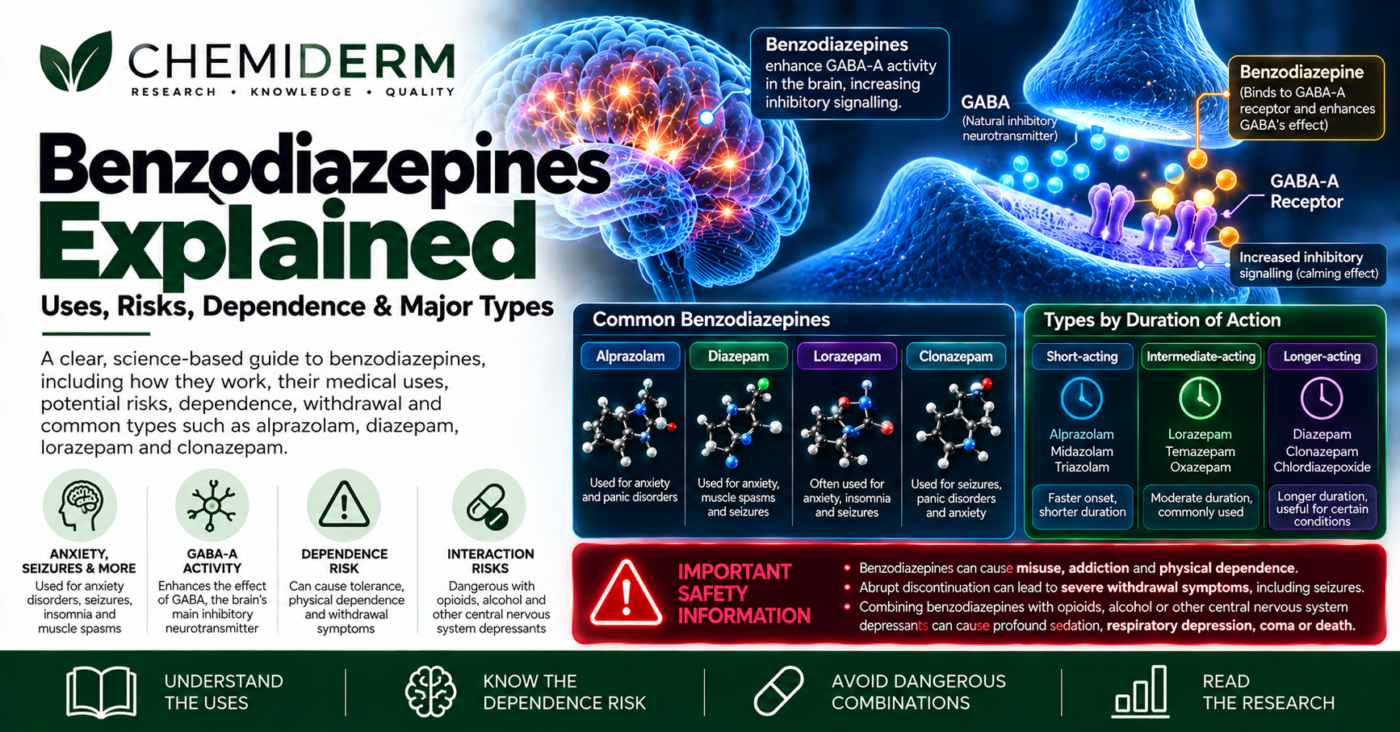
Benzodiazepines are a class of prescription medicines that slow activity in the central nervous system by enhancing the effects of the inhibitory neurotransmitter GABA.
Doctors may prescribe different benzodiazepines for conditions including anxiety disorders, panic disorder, insomnia, seizures and certain acute medical situations. FDA information specifically identifies anxiety, insomnia and seizures among conditions for which medicines in this class are used.
Examples include:
- Alprazolam
- Diazepam
- Lorazepam
- Clonazepam
- Midazolam
- Temazepam
- Triazolam
Although these medications can be medically useful, they also carry significant risks involving sedation, tolerance, misuse, physical dependence and withdrawal.
The FDA requires its strongest Boxed Warning for benzodiazepines to address risks of abuse, misuse, addiction, physical dependence and withdrawal reactions.
For additional evidence-focused pharmacology information, visit Chemiderm.com.
What Are Benzodiazepines?
Benzodiazepines are central nervous system depressants.
They do not simply “turn off” the brain. Instead, they enhance inhibitory signalling involving gamma-aminobutyric acid, better known as GABA.
GABA functions as one of the brain’s primary inhibitory neurotransmitters.
Increasing its effects can reduce excessive neural activity, which helps explain why benzodiazepines may produce:
- Calming effects
- Reduced anxiety
- Sedation
- Muscle relaxation
- Anticonvulsant effects
NIDA describes benzodiazepines as CNS depressants that increase GABA-related inhibitory signalling, producing calming or drowsy effects.
How Do Benzodiazepines Work?
Most benzodiazepine effects involve the GABA-A receptor.
GABA binds to GABA-A receptors and makes neurons less likely to fire.
Benzodiazepines bind at a separate site on the receptor and enhance GABA’s inhibitory effect.
This can reduce neuronal excitability throughout the central nervous system.
In simple terms:
GABA provides the inhibitory signal, while benzodiazepines strengthen that signal.
This mechanism contributes to their therapeutic effects as well as sedation and impaired coordination.
What Is GABA?
GABA stands for:
Gamma-Aminobutyric Acid
It is an inhibitory neurotransmitter involved in controlling nervous-system excitability.
GABA-related signalling contributes to functions involving:
- Anxiety regulation
- Sleep
- Muscle activity
- Seizure control
- Overall neural inhibition
This is why drugs that enhance GABA-A activity can have powerful effects on consciousness and coordination.
A separate Chemiderm guide will examine GABA and the nervous system in greater detail.
What Are Benzodiazepines Used For?
Depending on the specific medicine and medical situation, benzodiazepines may be used for conditions such as:
Anxiety Disorders
Some benzodiazepines can rapidly reduce severe anxiety symptoms.
Panic Disorder
Medicines such as alprazolam and clonazepam have been used in panic-related conditions.
Seizures
Certain benzodiazepines have important anticonvulsant effects.
Insomnia
Some shorter-acting or sedating benzodiazepines may be prescribed for short-term sleep problems.
Acute Medical Procedures
Certain agents can be used for sedation around medical procedures.
The specific drug chosen depends on its pharmacology, duration of action and the patient’s medical needs.
Common Benzodiazepines
Alprazolam
Alprazolam is commonly known by the brand name Xanax.
It is prescribed primarily for anxiety and panic-related conditions.
Because it can produce rapid central nervous system effects, misuse and dependence are important safety considerations.
Diazepam
Diazepam is commonly known as Valium.
FDA information lists approved uses including anxiety disorders, relief of acute alcohol-withdrawal symptoms, skeletal muscle spasm and use alongside other treatment for convulsive disorders.
Diazepam has a relatively long duration compared with many other benzodiazepines.
Lorazepam
Lorazepam is commonly known as Ativan.
It is used in several clinical contexts involving anxiety, sedation and seizure treatment.
Clonazepam
Clonazepam is commonly known as Klonopin.
It may be used for seizure disorders as well as panic-related conditions.
NIDA lists diazepam, clonazepam and alprazolam among commonly prescribed benzodiazepines.
Midazolam
Midazolam is frequently used for procedural sedation and certain acute seizure situations.
Temazepam
Temazepam is primarily associated with short-term insomnia treatment.
Triazolam
Triazolam is a shorter-acting benzodiazepine used for certain sleep disorders.
Short-Acting vs Long-Acting Benzodiazepines
Benzodiazepines can be grouped according to how quickly they act and how long their effects or metabolites persist.
These categories are not completely rigid, but drugs are often described as:
- Short acting
- Intermediate acting
- Long acting
Duration matters because it can influence:
- Sedation
- Dosing frequency
- Accumulation
- Withdrawal patterns
- Clinical use
A longer-acting medicine may remain active in the body substantially longer than a shorter-acting one.
Do Benzodiazepines Cause Drowsiness?
Yes.
Because benzodiazepines reduce nervous-system activity, common effects can include:
- Sleepiness
- Slower reaction time
- Reduced coordination
- Memory impairment
- Dizziness
- Difficulty concentrating
NIDA notes that people beginning CNS depressants commonly experience sleepiness and impaired coordination.
This is one reason activities requiring alertness can become dangerous while sedated.
What Is Benzodiazepine Tolerance?
Tolerance means that the body becomes less responsive to the same exposure over time.
NIDA notes that tolerance can develop with repeated CNS-depressant use, potentially reducing the effect previously experienced at the same prescribed amount.
Tolerance is different from both dependence and addiction.
These terms should not be treated as synonyms.
What Is Physical Dependence?
Physical dependence occurs when the nervous system adapts to continued exposure to a drug.
The FDA explains that physical dependence can occur after steady benzodiazepine use—even when medication is taken as prescribed.
If the medicine is then stopped abruptly or reduced too rapidly, withdrawal symptoms can occur.
Dependence does not automatically mean that a person has an addiction.
Dependence vs Addiction
These concepts are related but different.
Physical Dependence
The body has adapted to repeated exposure, producing withdrawal when the medication is abruptly reduced or stopped.
Addiction
Addiction involves compulsive drug use and continued use despite harmful consequences.
A patient can become physically dependent while taking a medicine appropriately without necessarily developing addiction.
However, benzodiazepines also have misuse and addiction potential, which is why FDA warnings address both issues.
What Is Benzodiazepine Withdrawal?
Withdrawal may occur when a physically dependent person suddenly stops or rapidly reduces a benzodiazepine.
Possible symptoms can include:
- Anxiety
- Irritability
- Insomnia
- Tremor
- Muscle discomfort
- Difficulty concentrating
- Panic symptoms
- Sensory disturbances
More severe reactions can include:
- Seizures
- Hallucinations
- Psychosis
- Severe confusion
The FDA warns that sudden discontinuation or overly rapid dose reduction can produce serious and potentially life-threatening withdrawal reactions.
Should Benzodiazepines Be Stopped Suddenly?
Generally, someone who has been taking benzodiazepines regularly should not abruptly stop them without medical guidance.
The FDA recommends gradual, individualized dose reduction when discontinuation is appropriate. It also emphasizes that there is no single tapering schedule suitable for every patient.
Anyone considering stopping a prescribed benzodiazepine should discuss it with the prescribing healthcare professional.
Can Withdrawal Last a Long Time?
For some people, symptoms can persist after the initial withdrawal period.
The FDA describes reports of prolonged withdrawal symptoms lasting weeks or even months in some patients.
Potential prolonged symptoms may involve:
- Anxiety
- Cognitive difficulties
- Depression
- Insomnia
- Tremor
- Abnormal sensations
Individual experiences vary widely.
Benzodiazepines and Opioids
This is one of the most dangerous combinations.
Both benzodiazepines and opioids can depress the central nervous system.
The FDA warns that combining benzodiazepines with opioid medicines or other CNS depressants can cause:
- Profound sedation
- Severe respiratory depression
- Coma
- Death
This interaction is significantly more dangerous than either class should be considered in isolation.
Benzodiazepines and Alcohol
Alcohol is another central nervous system depressant.
Combining alcohol with benzodiazepines can magnify sedation and impair breathing, consciousness and coordination.
The FDA specifically advises patients not to drink alcohol while using benzodiazepines because of the increased risk of serious and potentially life-threatening adverse effects.
Why Mixing CNS Depressants Is Dangerous
The danger is not simply that a person becomes “more sleepy.”
Multiple CNS depressants can compound effects on the brain systems responsible for maintaining:
- Consciousness
- Coordination
- Protective reflexes
- Breathing
This can result in dangerous respiratory depression.
Someone who is extremely difficult to wake or is experiencing breathing difficulty requires urgent medical care.
Can Benzodiazepines Affect Memory?
Yes.
Benzodiazepines can interfere with memory formation and cognitive processing.
The degree varies depending on:
- Specific medication
- Duration of action
- Individual sensitivity
- Other medications
- Medical conditions
Sedation and short-term memory impairment are particularly relevant in some procedural uses.
Are Benzodiazepines Safe for Long-Term Use?
Whether continued treatment is appropriate depends on the medical condition and individual patient.
However, concerns increase with prolonged exposure because of:
- Tolerance
- Physical dependence
- Withdrawal
- Cognitive effects
- Sedation
- Misuse potential
NIDA notes that benzodiazepines are generally not favored for unrestricted long-term use because of risks involving tolerance, dependence and addiction.
Treatment decisions should be individualized by a clinician.
Can Benzodiazepines Cause Overdose?
Benzodiazepines can contribute to serious poisoning, particularly when combined with other depressants.
Misuse involving opioids, alcohol or other CNS-depressing substances significantly increases the risk of severe outcomes.
The FDA states that abuse and misuse can result in overdose or death, especially when benzodiazepines are taken alongside opioids, alcohol or illicit substances.
Benzodiazepines vs Barbiturates
Both are central nervous system depressants, but they are separate drug classes.
Both enhance inhibitory signalling involving GABA, but they interact differently with GABA-A receptors.
Benzodiazepines generally replaced barbiturates for many conditions because they have a different safety profile.
However, benzodiazepines still carry significant risks involving sedation, dependence and interactions.
Benzodiazepines vs Z-Drugs
Medicines such as:
- Zolpidem
- Eszopiclone
- Zaleplon
are commonly referred to as Z-drugs.
They are chemically different from benzodiazepines but also act through GABA-A receptor systems.
NIDA distinguishes these non-benzodiazepine sleep medicines from benzodiazepines while noting their overlapping receptor activity.
Are All Anxiety Medicines Benzodiazepines?
No.
Many medications used to manage anxiety belong to completely different drug classes.
These may include:
- SSRIs
- SNRIs
- Buspirone
- Other psychiatric medications
Different medications have different mechanisms, onset times and risk profiles.
Benzodiazepines should therefore not be treated as synonymous with “anxiety medication.”
Benzodiazepines and GABA at a Glance
| Feature | Explanation |
|---|---|
| Main neurotransmitter system | GABA |
| Main receptor | GABA-A |
| Overall effect | Increased inhibitory signalling |
| Common medical roles | Anxiety, seizures, insomnia and acute sedation |
| Major risks | Sedation, tolerance, dependence and withdrawal |
| Dangerous combinations | Opioids, alcohol and other CNS depressants |
| Sudden discontinuation | Can cause severe withdrawal and seizures |
When Is Emergency Help Needed?
Serious symptoms can include:
- Difficulty breathing
- Severe sedation
- Inability to wake
- Seizures
- Severe confusion
- Loss of consciousness
The FDA advises emergency medical attention for serious symptoms such as breathing problems or seizures.
How This Fits Into the Chemiderm Pharmacology Hub
This guide is part of the broader pharmacology and neuroscience content cluster on Chemiderm.com.
Related resources include:
- Dextromethorphan (DXM)
- GABA and the nervous system
- Serotonin and neurotransmitters
- Benzodiazepine dependence
- Drug interactions
- CNS depressants
- What is DMT?
- DMT and the brain
- Nootropics and racetams
The purpose is to organize related pharmacology topics into connected educational resources rather than isolated pages.
Frequently Asked Questions
What are benzodiazepines?
Benzodiazepines are prescription central nervous system depressants that enhance GABA-A receptor signalling and are used for conditions including anxiety, insomnia and seizures.
What are common benzodiazepines?
Examples include alprazolam, diazepam, lorazepam and clonazepam.
How do benzodiazepines work?
They enhance GABA-related inhibitory signalling at GABA-A receptors, decreasing nervous-system activity.
Can benzodiazepines cause dependence?
Yes. Physical dependence can occur even when the medication is taken as prescribed.
Can you stop benzodiazepines suddenly?
Abrupt discontinuation after dependence has developed can cause serious withdrawal, including seizures. Medical guidance is recommended for discontinuation.
Are benzodiazepines addictive?
They can be misused and can cause addiction in some people. FDA boxed warnings address misuse, abuse, addiction and dependence.
Why are benzodiazepines and opioids dangerous together?
Both suppress the central nervous system, and the combination can cause profound sedation, respiratory depression, coma or death.
Can alcohol be mixed with benzodiazepines?
The FDA warns against drinking alcohol with benzodiazepines because it can substantially increase serious CNS-depressant effects.
Final Thoughts
Benzodiazepines are medically important drugs that work primarily by enhancing the effects of GABA at GABA-A receptors, reducing nervous-system excitability.
This explains their usefulness in anxiety, seizures, insomnia and acute clinical situations—but also many of their major risks.
Repeated use can lead to tolerance and physical dependence, while abrupt discontinuation can cause serious withdrawal reactions. Combining benzodiazepines with opioids, alcohol or other central nervous system depressants substantially increases overdose and respiratory-depression risk.
The safest use is exactly as prescribed, with medication changes or discontinuation handled with professional medical guidance.
For more evidence-focused pharmacology and neuroscience resources, visit Chemiderm.com.
