Uncategorized
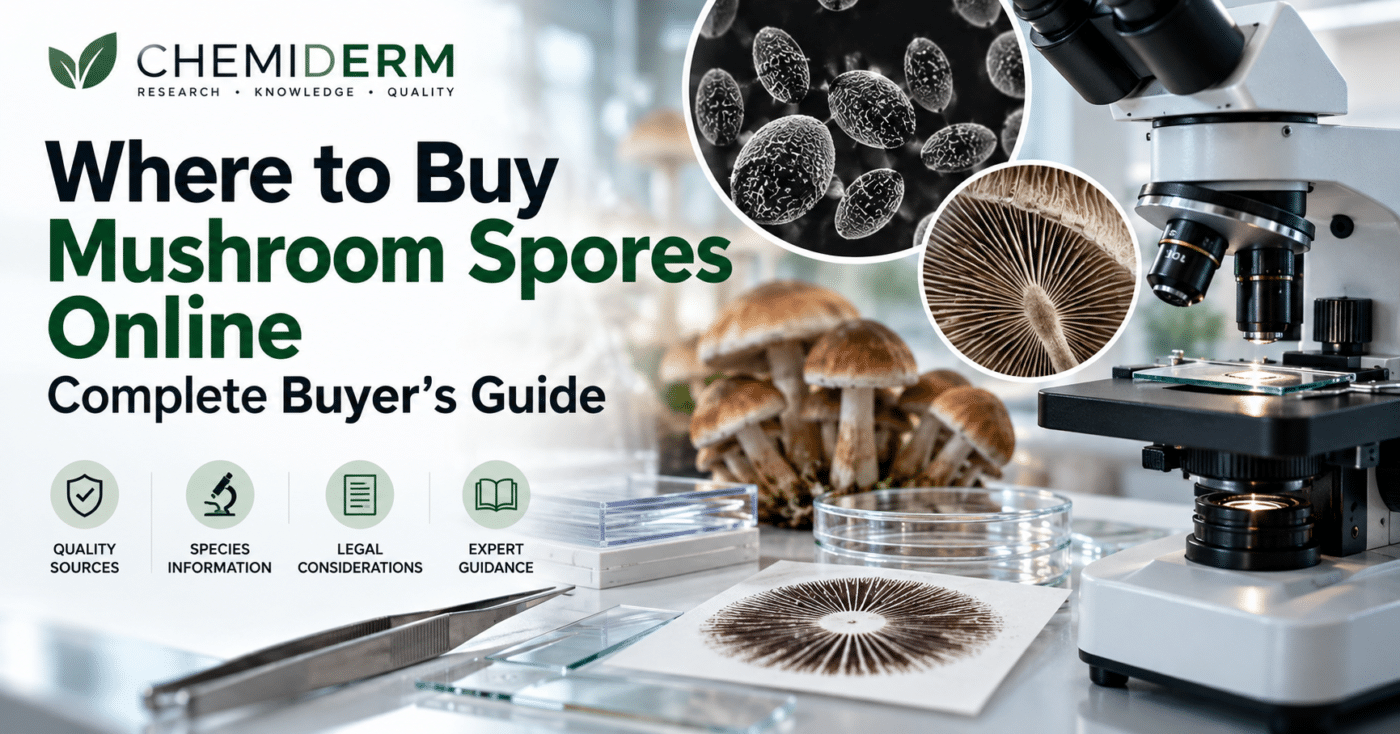
Where to Buy Mushroom Spores Online: Complete Buyer’s Guide
Oct
Searching for where to buy mushroom spores online can quickly become confusing. Buyers may encounter spore syringes, spore prints, swabs, liquid samples, microscopy supplies, different mushroom species, and suppliers making very different claims about their products.
The right choice depends first on what you need the spores for.
Mushroom spores are commonly collected for microscopy, fungal taxonomy, educational study, species identification, and other lawful research purposes. Because rules concerning particular mushroom species can differ significantly between countries, states, and other jurisdictions, researchers should always check the laws that apply to them before ordering or possessing any specimen.
This guide explains what to look for when researching mushroom spores online, the major formats available, how to compare sellers, and how to avoid poor-quality or incorrectly labelled material.
For more research-related information, visit Chemiderm.com.
What Are Mushroom Spores?
Mushroom spores are microscopic reproductive cells produced by fungi.
They are roughly comparable to seeds in plants in terms of biological function, although fungi and plants reproduce in very different ways.
Researchers may examine spores to study characteristics including:
- Spore shape
- Size
- Surface texture
- Colour
- Distribution
- Species differences
- Microscopic morphology
These characteristics can help researchers distinguish between fungal species and understand how different mushrooms are classified.
Because spores are microscopic, a quality microscope is typically one of the most important tools used for legitimate spore examination.
Where to Buy Mushroom Spores Online?
People searching for mushroom spores for sale generally encounter several types of specialist suppliers.
These may include microscopy suppliers, fungal specimen vendors, biological research suppliers, specialist mycology stores, and laboratory supply businesses.
When comparing sources, focus on transparency rather than simply choosing the cheapest listing.
A professional supplier should clearly identify what is being offered and provide useful information about the specimen.
Before purchasing, check for:
- Clearly stated species information
- Proper specimen labelling
- Product photographs
- Packaging information
- Customer-support details
- Storage guidance
- Terms and conditions
- Shipping restrictions
- Legal-use notices where appropriate
If you need assistance identifying information available on the site, you can also use the Chemiderm contact page.
Mushroom Spore Syringes
A mushroom spore syringe is one of the most commonly encountered specimen formats.
It normally consists of fungal spores suspended in sterile liquid inside a sealed syringe.
For microscopy researchers, syringes can make it easier to transfer a small specimen onto a microscope slide for examination.
When evaluating a spore syringe, useful information includes the species name, preparation date where available, packaging condition, storage recommendations, and specimen identification.
The syringe should also arrive properly sealed.
Researchers should avoid products with damaged packaging, missing labels, or unclear identification.
Mushroom Spore Prints
A spore print is another common method of preserving fungal spores.
A mushroom naturally releases spores from structures underneath its cap. When spores are collected on a suitable surface, they can form a visible pattern known as a spore print.
Spore prints are particularly interesting for taxonomy because spore colour can help with fungal identification.
Depending on the species, prints may appear:
- Brown
- Black
- Purple-brown
- White
- Cream
- Rust-coloured
- Pinkish
A spore print can also preserve a large amount of microscopic material in a compact format.
Spore Swabs
Spore swabs are another format occasionally offered by specialist suppliers.
A sterile swab is used to collect spores from a specimen or print.
Swabs are compact, easy to label, and convenient to store, making them useful for some microscopy collections.
As with syringes and prints, accurate labelling is important.
A specimen with no reliable species identification has considerably less research value.
Spore Syringe vs Spore Print vs Spore Swab
There is no single format that is automatically best for every researcher.
Spore Syringe
Suitable for researchers who want spores suspended in liquid and easily transferred onto a microscope slide.
Spore Print
Useful for collectors and researchers interested in examining spore colour, morphology, and larger preserved samples.
Spore Swab
Compact and convenient for certain specimen collections and microscopy applications.
Your choice should depend on the type of research you intend to conduct.
What to Look for When Buying Mushroom Spores Online
Not every website offering mushroom spores provides the same level of information or quality control.
Before choosing a source, consider several factors.
1. Correct Species Identification
Accurate identification should be one of your highest priorities.
Scientific names are especially helpful because common mushroom names can vary between regions and sellers.
2. Clear Product Information
A good listing should explain what the customer is receiving.
Important information may include:
- Species
- Specimen format
- Quantity
- Packaging
- Storage recommendations
- Intended research purpose
Avoid listings that provide almost no description.
3. Packaging Quality
Microscopy specimens should arrive properly sealed and protected.
Damaged containers can compromise specimen integrity.
4. Customer Support
Reliable support becomes valuable when you have questions about specimen identification, packaging, documentation, or an existing order.
Researchers using Chemiderm.com can review the site’s available information or contact support when clarification is required.
5. Legal Restrictions
This is particularly important.
The legal status of spores and specific fungal species differs between jurisdictions.
A specimen that can legally be possessed for microscopy in one location may be restricted elsewhere.
Always research your local laws before placing an order.
Why Species Information Matters
The fungal kingdom contains an enormous number of species.
Even closely related mushrooms can produce spores with measurable differences in:
- Dimensions
- Shape
- Wall thickness
- Colour
- Surface characteristics
- Microscopic structures
For researchers studying fungal taxonomy, accurate species identification makes comparison significantly more useful.
This is also why search terms such as Psilocybe cubensis spores, Psilocybe cyanescens spores, Psilocybe azurescens spores, and liberty cap spores should eventually be supported by separate species-information pages rather than forcing all of them into a single article.
That structure creates clearer information for readers and stronger topical organization for search engines.
Are Mushroom Spores the Same as Mushroom Seeds?
No.
People sometimes search for terms such as “mushroom seeds,” but mushrooms do not produce seeds.
Fungi reproduce through spores.
Seeds contain a plant embryo and stored nutrients, while fungal spores are single or multicellular reproductive structures associated with fungi and certain other organisms.
Using scientifically accurate terminology is especially important when researching specimens online.
The correct phrase is usually mushroom spores, not mushroom seeds.
What Does a Mushroom Spore Look Like Under a Microscope?
The appearance depends on the species.
Researchers may observe characteristics such as:
- Elliptical spores
- Round spores
- Smooth surfaces
- Ornamented surfaces
- Thick or thin walls
- Different colours under transmitted light
These microscopic details form part of fungal identification and classification.
Multiple characteristics are normally considered together rather than relying on one feature alone.
How Should Mushroom Spores Be Stored?
Storage requirements can differ depending on specimen format and supplier recommendations.
In general, researchers should protect specimens from excessive heat, moisture, contamination, and direct sunlight.
Original labels should also remain attached to specimens.
For a research collection, consider recording:
- Scientific name
- Supplier
- Date received
- Specimen format
- Storage date
- Reference number
Good documentation makes later comparison much easier.
Common Mistakes When Buying Mushroom Spores
Choosing Only by Price
The cheapest specimen is not necessarily the best research sample.
Accurate identification and proper packaging may be more important than saving a small amount of money.
Ignoring Scientific Names
Common names can be ambiguous.
Whenever possible, confirm the scientific name.
Ordering Without Checking Local Rules
Regulations differ widely.
Researchers should check applicable laws before purchasing particular species.
Buying Poorly Labelled Samples
A specimen with uncertain identification has limited value for serious microscopy or taxonomy work.
Confusing Spores With Finished Mushrooms
Spores and mushroom fruiting bodies are completely different biological materials and may also be treated differently by local regulations.
Building a Mushroom Microscopy Collection
Researchers interested in comparative microscopy may eventually build collections containing multiple fungal species.
A properly documented collection allows researchers to compare characteristics between specimens.
Useful records can include species names, dates, photographs, microscope observations, spore measurements, and reference notes.
This creates considerably more scientific value than simply collecting unlabelled samples.
Frequently Asked Questions
Where can I buy mushroom spores online?
Specialist microscopy, mycology, biological specimen, and research suppliers may offer mushroom spores. Verify the supplier, specimen identification, intended use, and applicable local laws before ordering.
Can mushroom spores be examined under a microscope?
Yes. Microscopy is one of the common scientific methods used to examine fungal spores and compare characteristics between species.
What is a mushroom spore syringe?
A mushroom spore syringe generally contains fungal spores suspended in sterile liquid for specimen handling and microscopy applications.
What is a spore print?
A spore print is a deposit of spores collected from a mushroom’s spore-producing surface. The resulting pattern and colour can assist fungal identification.
Are mushroom spores legal?
The answer depends on the species and jurisdiction. Regulations may differ between countries, states, provinces, and municipalities. Always check the laws applying to your location.
Are mushroom spores the same as mushroom seeds?
No. Mushrooms are fungi and reproduce through spores rather than seeds.
What should I check before buying mushroom spores?
Check species identification, specimen format, packaging, supplier information, storage recommendations, shipping restrictions, and applicable laws.
What information should appear on a spore specimen?
Ideally, a specimen should include the species name and enough identifying information to distinguish it from other samples.
Final Thoughts
If you are researching where to buy mushroom spores online, concentrate on specimen quality, accurate identification, good documentation, supplier transparency, and legal compliance.
Spore syringes, prints, and swabs can each serve different microscopy and collection purposes, so the best format depends on your research objectives.
The most important principle is to know exactly what specimen you are acquiring and why you need it.
For additional research information and site resources, visit Chemiderm.com.
Where to Buy Mushroom Spores Online Where to Buy Mushroom Spores Online Where to Buy Mushroom Spores Online Where to Buy Mushroom Spores Online Where to Buy Mushroom Spores Online Where to Buy Mushroom Spores Online Where to Buy Mushroom Spores Online Where to Buy Mushroom Spores Online Where to Buy Mushroom Spores Online Where to Buy Mushroom Spores Online Where to Buy Mushroom Spores Online Where to Buy Mushroom Spores Online Where to Buy Mushroom Spores Online Where to Buy Mushroom Spores Online Where to Buy Mushroom Spores Online
